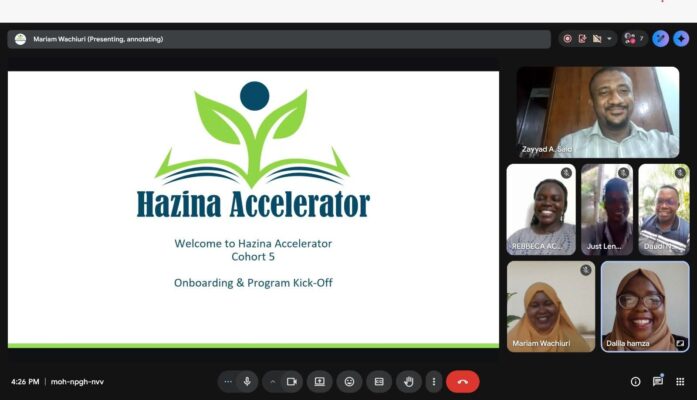
What Could Possibly Connect a Hair Restorer, an Okra Farmer, a mental health advocate , a Fashion Creative and a Tech Builder?
At first glance, absolutely nothing.
One was speaking about hair restoration oils designed to help women experiencing postpartum shedding and hair loss. Another was still nurturing the early stages of an okra farming dream.
One carried a vision centered on mental health support for young mothers, while another spoke the language of fashion, modeling and artistic expression. Somewhere in the same virtual room sat a tech builder determined to help schools move away from outdated systems into a more digital future.
Different industries.
Different personalities.
Different ambitions.
Yet for three months, they all logged into the same Zoom room carrying something surprisingly similar: the courage to build an idea before the world fully understands it.
The Hazina Accelerator Cohort 5 onboarding session did not begin with financial projections or polished pitches. Instead, it began with something far more human.
A question.
“If you were an animal, what animal would you be?”
“…And one fun fact about it.”
For a moment, the virtual meeting shifted. Cameras became less intimidating. The atmosphere softened. Founders who had prepared to explain businesses suddenly found themselves explaining identity instead.
And perhaps that was the real beginning of the journey.
Because entrepreneurship is rarely just about products. It is about personality. Instinct. Patience. Adaptability. Resilience.
And here we go!!!!!
Daudi Ngoa, founder of Island Drops, was building from a deeply personal place, transforming a lived family experience into a solution that restores confidence for women going through postpartum hair loss and emotional transition.
Rebecca Achieng, founder of Care Mind Community Network, was building something less visible but deeply urgent, a space for young mothers to confront mental health struggles that are often spoken about in whispers and not rooms.
Another was still in the soil of possibility.
Carry Ndamanywa, the InuaOkra farmer in the making, was nurturing an idea that had not yet fully emerged into the market, but already carried the weight of patience, agriculture and faith in growth that cannot be rushed.
Then came systems and structure.
Mogulh Kiti, the tech builder behind Chuopap, was reimagining how schools operate, replacing outdated manual systems with a digital framework designed to bring efficiency, order and modern structure into education management.
And finally, expression in its most visual form.
Eric Lenjo, founder of Just Lenjo Arts, was building through fashion and modeling .Where identity is not just spoken, but worn, shaped and performed through creativity.
Individually, their businesses appeared unrelated.
But slowly, week after week, another connection emerged.
Each of them was solving a human problem.
• Restoring confidence.
• Creating emotional support.
• Strengthening food systems.
• Improving efficiency.
• Helping people express identity.
The bootcamp became more than lectures and assignments. It became a meeting point between ideas and the people brave enough to carry them.
There were moments of confidence. Moments of silence. Internet interruptions. Awkward pauses before speaking. Assignments submitted late at night. Business concepts questioned, reshaped and refined.
Some arrived speaking cautiously about their ideas.
By the end of the first phase, they were beginning to speak like founders.
And perhaps that is what made the journey remarkable.
Not the industries.
Not the presentations.
Not even the business plans.
But the quiet transformation of ordinary people slowly learning to take their own dreams seriously, transforming ideas into scalable businesses capable of creating real impact beyond the Zoom room.